

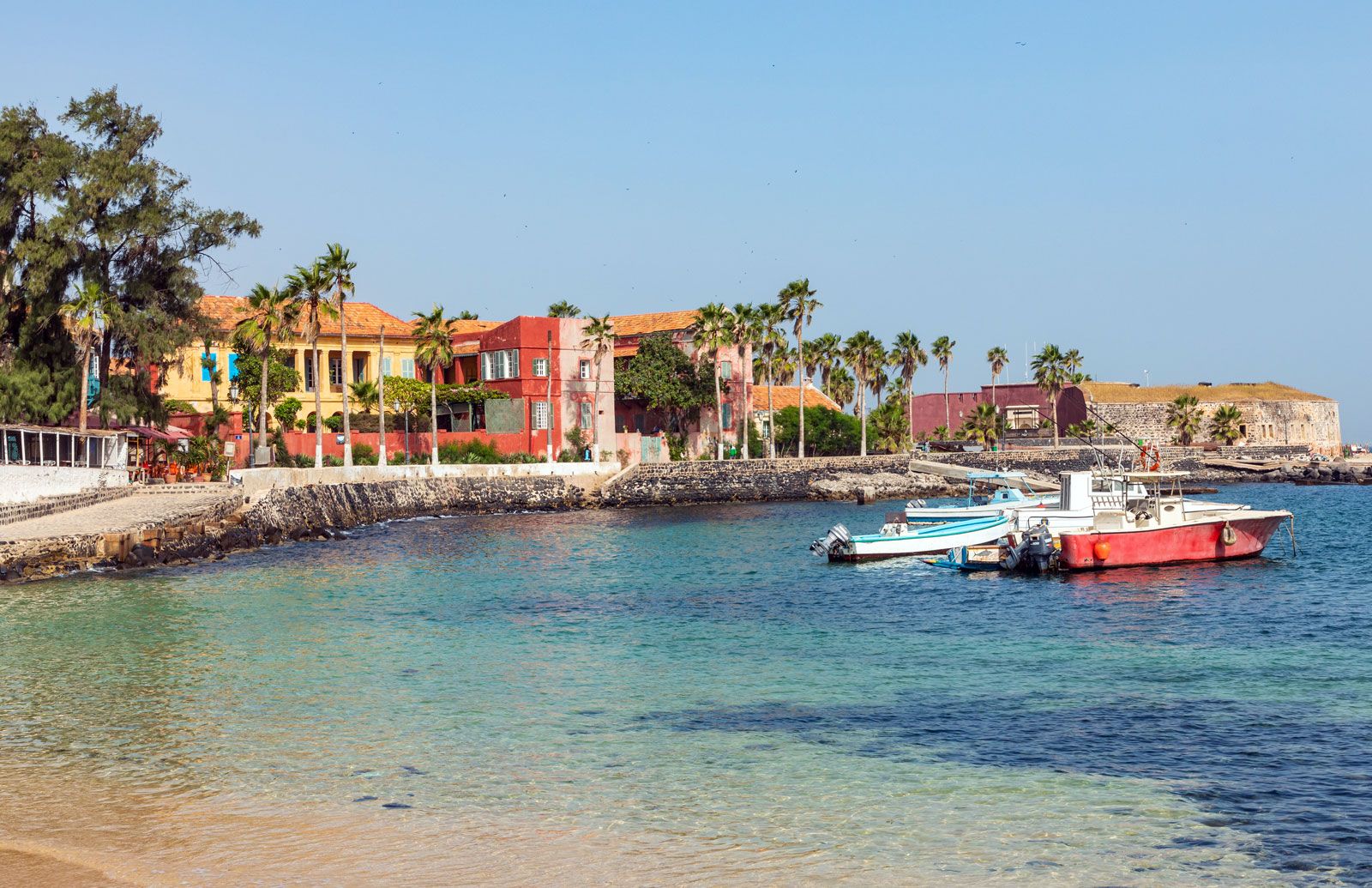
Goree Island, Senegal sits just 3 kilometers off the coast of Dakar and carries the full weight of the Transatlantic slave trade on its shores. A UNESCO World Heritage Site since 1978, it’s the most visited site in West Africa for Diaspora heritage travelers and one of the most spiritually significant places on earth.
What Makes Goree Island Different From Every Other Heritage Site in Africa?
While Ghana holds Cape Coast and Elmina Castles, Senegal holds something equally profound: the Door of No Return. Ghana represents the destination of the Diaspora’s return. Goree Island represents the departure point. The last ground the ancestors walked before crossing the Atlantic.
That difference matters. It changes how you move through a site. At Goree, you’re walking in the direction the ancestors were forced to walk. Toward the ocean. Toward the unknown.
Continent Tours has guided Diaspora groups through both Senegal and Ghana for over 20 years. We operate with wholly-owned offices in Dakar and Accra, staffed by historians, cultural advisors, and community liaisons who were born in the cities you’re visiting. This is not a packaged tour with a script. It’s an informed, dignified encounter with history.
What to Expect Inside the House of Slaves (Maison des Esclaves)
The Maison des Esclaves was built in 1776. Its pink walls have faded to a soft salmon, worn by two and a half centuries of Atlantic wind, salt, and time. From the outside, it looks almost gentle. Inside, it does not.
The ground floor held the cells. Small, dark, and low-ceilinged, they were built to hold as many people as possible with as little space as possible. Men were separated from women. Children were separated from parents. The sick were separated from the healthy.
The air inside is still and heavy. It smells of stone, salt, and something older.
At the top of the narrow staircase sits the Door of No Return. A rectangular opening cut into the sea-facing wall, it frames a direct view of the Atlantic Ocean. No dock. No gradual shore. Just open water.
You stand there. You understand.
Our guides at Continent Tours do not rush this moment. There is no schedule that overrides what you need to feel when you’re standing in that doorway.
Who Built the House of Slaves, and Why Does That History Matter?
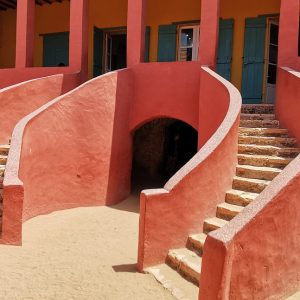
The Maison des Esclaves was built by Dutch traders and later managed by French colonists. It was restored and opened to the public largely through the decades-long efforts of Joseph N’Diaye, its legendary curator, who personally guided heads of state, civil rights leaders, and Diaspora delegations through the building from 1962 until his death in 2009.
Understanding that history, the colonial hands that built it and the Senegalese hands that preserved it, is part of what makes a guided experience essential. Our Dakar-based team carries that full context into every visit.
Is Goree Island Only About the Past?
No. And this surprises nearly every first-time visitor.
Once you step off the ferry and clear the southern end of the island near the House of Slaves, Goree opens into something unexpected. Car-free streets. Bougainvillea in purple and red spilling over colonial-era walls. Cafes with terraces that look directly onto the Atlantic. The air shifts from heavy to warm, dry, and faintly floral.
Goree today is a living community of about 1,200 residents, many of them artists, teachers, and craftspeople. The island reclaimed itself. That reclamation is not separate from the history. It is the continuation of it.
The Artists of Goree: What Are the Famous Sand Paintings?
The sand paintings of Goree are unlike anything made elsewhere on the continent. Local artists collect sand in dozens of shades, from the pale ivory of the Sahara dunes to the deep volcanic red-black of the island’s own rock, and use it to build layered, textured images without a single drop of paint.
Markets along the island’s main street sell them in sizes from postcard to canvas. They depict fishermen, village life, baobab trees, and the Atlantic coast. They are not souvenirs. They are originals, priced accordingly, made by the hands of artists who grew up on this island.
Our guides know which artists are worth visiting in their studios. This is not information you find online.
The Mosque and the Church: What Does Teranga Actually Mean?
On the island’s northern end, a mosque and a Catholic church stand within meters of each other. Both active. Both maintained. Neither one dominant.
This is Teranga. The word is Wolof, Senegal’s most widely spoken language, and it translates roughly as hospitality. But that translation doesn’t carry the full weight of it. Teranga is a philosophy. It’s the idea that a stranger is not a stranger — that the person arriving deserves to be received as a guest, regardless of where they come from or what they believe.
For the Diaspora traveler arriving in Senegal for the first time, that idea lands differently than it does on paper. You feel it in the way people greet you on the ferry, in the way vendors step back when you need a moment, in the way the island simply makes room for whatever you’re carrying.
Takeaway: Teranga is not a marketing slogan. It’s the lived culture of Senegal, and you feel it from the first crossing.
Dakar Beyond the Ferry: What to Do Before and After Goree Island
Most visitors spend three to five hours on Goree Island. The ferry back deposits them at the Port of Dakar in the early afternoon with the rest of the day still ahead of them.
That afternoon matters. What you do with it changes what the whole trip means.
Dakar is a city of contradictions held together by Teranga. Loud and intimate. Chaotic and considered. It is one of the most culturally alive capitals on the African continent, and it rewards the traveler who arrives with no fixed plan.
Start at the Marché Kermel, the covered colonial-era market near the port. Not for shopping, but for orientation. The colors, the vendors, the smell of thiéboudienne (Senegal’s beloved national dish of rice slow-cooked with fish and vegetables) being prepared at the stalls along the edge will bring you back into the present in the way that only sensory overload can after a morning on Goree.
From there, the Plateau neighborhood is ten minutes on foot. The French colonial architecture along the Boulevard de la République frames a version of Dakar that is formal and composed. Walk north toward the Medina, the city’s historic residential and commercial heart, and that composure dissolves into something rawer and more alive. Workshops, tailors, musicians rehearsing in doorways, the call to prayer arriving from three directions at once.
For the evening, the Almadies district along the western tip of the Cap-Vert Peninsula is where Dakar’s creative class eats and performs. Live Mbalax, Senegal’s defining musical rhythm built on the sabar drum and made internationally famous by the legendary Youssou N’Dour, plays in venues that don’t announce themselves with signs. Our Dakar team knows which doors to knock on.
Goree Island is the reason to come to Senegal. Dakar is the reason to stay.
Continent Tours builds full Dakar city programs around every Goree Island visit, for solo travelers and groups alike.
How Do You Get to Goree Island? A 2026 Logistics Guide
Getting to Goree is straightforward, but knowing the details makes it better.
The Ferry from Dakar
- Departs from the Embarcadere de Goree terminal at the Port of Dakar, near the Place de l’Independance
- Crossing time: 20 to 25 minutes, with multiple daily departures from 6:15 AM through 11:30 PM
- Round-trip fare for foreign visitors in 2026: approximately 5,200 CFA francs (roughly $8.50 USD)
- Morning crossings are calm and clear; by midday a light haze settles over the water and softens the view of the island approaching.
Continent Tours handles all ferry logistics, including priority boarding for groups, as part of our Senegal heritage packages.
What Is the Best Time of Year to Visit Goree Island?
- Best window: November through February. Dakar’s dry season brings cooler temperatures (low 20s Celsius / low 70s Fahrenheit), low humidity, and no rain. The light in December and January is particularly striking in the late afternoon, when the island’s pink and ochre walls catch the sun at a low angle.
- Avoid if possible: July and August. The Atlantic humidity during Dakar’s rainy season makes the island feel heavy in a way that compounds the weight of what you are already processing there.
Do You Need a Visa for Senegal in 2026?
This is one of the most common questions our Dakar team answers before every departure.
Senegal is one of West Africa’s most accessible countries for international visitors. Citizens of the United States, United Kingdom, Canada, and the European Union can enter visa-free for stays of up to 90 days. Most Caribbean nationals also qualify.
For those from countries like Brazil, Argentina, and South Africa, a free visa is issued upon arrival at the airport. However, if you are planning a road trip across a land border, you’ll want to secure a physical visa from a Senegalese Embassy in advance to ensure a smooth crossing.
All other nationalities can easily obtain a standard tourist visa via an embassy before travel.
PRO-TIP: Continent Tours Visa Service for Senegal — 2026
If you’re combining countries, visa coordination across multiple entry points can get complicated quickly. Our team is happy to walk you through the requirements before you finalize your plans.
Why Continent Tours Is the Right Specialist for Senegal Heritage Travel
There are operators who know Senegal. And there are operators who know every stone of Goree Island, the name of the ferry captain on the 8 AM crossing, and which guide inside the House of Slaves will spend an extra hour with a group that needs more time.
Continent Tours is the second. We’ve been operating in West Africa since 2006, with wholly-owned offices in Dakar staffed by local experts who grew up speaking Wolof, French, and English. Our West Africa heritage itineraries are not adapted from a standard template. They are built conversation by conversation with each client.
We also know when to step back. Some moments on Goree Island belong only to you.
Frequently Asked Questions
Is Goree Island safe for solo travelers in 2026?
Yes. Goree Island is one of the safest and most welcoming sites in West Africa. It’s a car-free, residential community with a strong local presence. Solo travelers, including solo women travelers, consistently rate it among their safest experiences on the continent. Dakar as a city requires the standard urban awareness of any major capital, but the island itself is calm, small, and easy to navigate.
How long should I spend on Goree Island?
Plan for a minimum of four hours, though a full day is better. The House of Slaves alone warrants 90 minutes if you’re going through it properly. Add time for the sand painting markets, the mosque and church visit, lunch at one of the island’s seafood terraces, and the return ferry with enough daylight to see the Dakar skyline on the crossing back.
Can I visit Goree Island and Cape Coast Castle on the same trip?
Yes, and many Diaspora travelers do exactly that. A Senegal-Ghana heritage itinerary typically runs 10 to 14 days and allows full visits to both sites with cultural programming, ancestral naming ceremonies in Ghana, and time in both Dakar and Accra. Continent Tours designs these dual-country itineraries regularly.
What should I know before visiting the House of Slaves?
Go with a guide. The building’s history is layered, emotionally demanding, and contested in certain details by historians. A knowledgeable guide does not just narrate — they help you process. Wear comfortable shoes; the floors are uneven and some passages are narrow. Bring water. And give yourself permission to take as long as you need at the Door of No Return. There’s no right way to stand there.
When you’re ready to make this journey, we’re here to help you plan it with the care and depth it deserves.
Explore our Senegal Heritage Packages
In our next post, we continue our journey through West Africa’s most profound heritage destinations. Follow us to be the first to read it.

Comment (0)